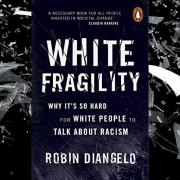
White Fragility is another wonderful book to read this Black History Month. The author Dr. Robin Diangelo has been teaching diversity training for 20 years. And she happens to teach at my alma mater, the University of Washington in Seattle. So cool!
Like Kendi, Diangelo speaks about her own discrimination and racism and the need for us all to consider important aspects of how we participate in racism even when our intention is to “not be racist” or even “antiracist.”
PLUS, through Metro United Way, Diangelo will be offering a “Beyond Buzzwords” event on February 23rd, 2021 from 12pm-1:15pm. Register HERE for FREE to attend!
Speaking of buzzwords, if you are noticing some phrases pop up that you aren’t familiar with, I encourage you to Google them and find out more. When we know better, we do better!
https://mindfulness-center.com/wp-content/uploads/2021/02/jpg.jpeg9001200Megan Bartleyhttps://mindfulness-center.com/wp-content/uploads/2022/10/logo-small.pngMegan Bartley2021-02-19 18:18:062021-02-19 18:18:06Beyond Buzzwords: White Fragility
#1 NEW YORK TIMES BESTSELLER • From the National Book Award–winning author of Stamped from the Beginning comes a “groundbreaking” (Time) approach to understanding and uprooting racism and inequality in our society—and in ourselves.
“The most courageous book to date on the problem of race in the Western mind.”—The New York Times
NAMED ONE OF THE BEST BOOKS OF THE YEAR BY The New York Times Book Review • Time • NPR • The Washington Post • Shelf Awareness • Library Journal • Publishers Weekly • Kirkus Reviews
As a cis white woman (she/her/hers), I am fully aware that there is plenty I do not know about racism. And not only am I not an expert on racism, there is plenty I don’t know about sexism, agism, ablism, and other prejudices. I also recognize that I still participate in racism and other prejudices even when I believe I am consciously trying my best “Not To Be” racist or prejudice.
Author Ibrim X. Kendi brilliantly addresses the difference between “not being a racist” and being “antiracist.” He helps the reader understand that whether we like it or not, we are all participating in racism (even him!), even when we would consider ourselves “not racist.”
While this is a “how to” book, it’s also a wonderful narrative of Kendi’s life. Not only does he talk about his journey with racism and discrimination, but also with cancer. This book is a great “must read.”
https://mindfulness-center.com/wp-content/uploads/2021/02/IMG_2720-1024x683-1.jpg6831024Megan Bartleyhttps://mindfulness-center.com/wp-content/uploads/2022/10/logo-small.pngMegan Bartley2021-02-12 15:17:182021-02-12 21:29:32How To Be An Antiracist – February 2021 Monthly Book Giveaway
This year Louisville Mindfulness Center is giving away one book a month that has been influential to me in my life to better understand and love myself, my relationships, and in the work that I do as a therapist, mindfulness coach, speaker, and author.
January 2021 we are giving away, “The Seven Spiritual Laws of Success” by Deepak Chopra (scroll down to enter to win!)
Today I’m reflecting on the Law of Giving.
For those of us who are natural caregivers or maybe even people pleasers, we tend to give and give and give and give and give some more which can lead to us feeling depleted and perhaps frustrated when we feel no one is looking out for us and our well-being.
How I understand the Law of Giving is that there has to be a balance of Giving and Receiving. This creates a FLOW. Energy flowing out and energy flowing into our lives. If energy is only flowing out of us, then we will feel exhausted if we aren’t allowing others to care for us, or making time for us to care for ourselves. This is why we preach the necessity of “self-care” and “loving yourself.”
It’s the premise behind putting your oxygen mask on first and then assisting your dependents. If you are pouring all the water out of your pitcher into other people’s water glasses, and you don’t have a supply of water coming into your pitcher, then you will soon become dehydrated, emaciated, and feel “stuck” since there is no hydration to sustain you. And I don’t know about you, but when I’m hungry or thirsty my moods get grumpy and negative and resentful that I’m giving everyone what they need, but not receiving what I need in return.
Creating this FLOW involves allowing others to give to you…
To help you out, to bring you treats and gifts, to offer their compliments and for you to receive them gratefully and without guilt. I’m sure when you are offering your help to others you are being genuine and truly want others to take you up on your offer. How do you feel when people turn you down? Perhaps not trusted, not good enough, brushed off? When we say “no thanks” to others when they are offering help to us, we are perhaps sending these messages to them without even realizing it.
I know what you’re thinking… you’re thinking you say “no thanks” to others because you don’t want to burden them with your stuff. So ask yourself this question, “When you offer your help and assistance to others, do you feel burdened by them?”
Perhaps you can challenge yourself to get the FLOW going by asking for help.
I know, I know, many of us have a hard time asking for help, but again, when someone asks you for help, I wonder if you sometimes feel special, or trusted, or honored that they thought you were the person they could rely on for help.
When we start to shift our mindset from worrying about burdening others to creating the wonderful flow of giving and receiving, we are choosing to allow others to think of us, to “have our backs,” and we are honoring others with trusting them to help us out.
The visual I like to think of is of the ocean waves coming up to shore on the beach. There is a constant motion of waves coming in to shore and going back out again. The movement doesn’t stop, EVER. There is a flow of water coming in and a flow of water going back out to sea. The ocean is in constant FLOW. Wouldn’t it be wonderful to feel this flow in your own life? Perhaps you already do in certain areas. And perhaps there are other areas where you might challenge yourself to be more in “FLOW” with life.
I’d love to hear your feedback and if this was helpful to you. If there are other topics you’d like me to write about, please let me know!
https://mindfulness-center.com/wp-content/uploads/2021/01/20201115_164053-scaled.jpg19602560Megan Bartleyhttps://mindfulness-center.com/wp-content/uploads/2022/10/logo-small.pngMegan Bartley2021-01-20 16:12:512021-01-21 21:10:23The Law of Giving (and Receiving) = FLOW
One of the fun questions that was asked during our Mindfulness Center holiday party was, “What’s your favorite holiday?!” We had many varied answers from Easter to Fourth of July to Thanksgiving to Christmas. My answer was unique. My favorite holiday is New Year’s Eve and Day.
I have always liked the idea of a fresh start, of starting anew. Of putting the past behind me and stepping into the unknown of the future. Now, with that said, I am a planner, in a big way, so I usually have many goals and intentions for the New Year. I also LOVE to challenge myself…to learn new things, read new books, try new activities, explore new places, eat new foods…you name it.
One of my favorite books is The Seven Spiritual Laws of Success by Deepak Chopra. One of the laws is the Law of Detachment. Choprah so elequently writes,“In detachment lies the wisdom of uncertainty . . . in the wisdom of uncertainty lies the freedom from our past, from the known, which is the prison of past conditioning. And in our willingness to step into the unknown, the field of all possibilities, we surrender ourselves to the creative mind that orchestrates the dance of the universe.”
Aaaahhhh…. I could read that passage over and over. It seems so simple, freeing, beautiful and exciting.
So in the spirit of newness and giving, I am excited to announce that every month this year we will be giving away one of my most favorite books that has helped me
1) learn new things,
2) see old things in new ways, and/or
3) challenge the norm of what we “know.”
In January 2021 we will give away a copy of The Seven Spiritual Laws of Success. Simply submit your information below to enter the drawing. We will announce our winner in our email newsletter the last Friday of every month. If you can’t wait to read the book… Order it HERE!
https://mindfulness-center.com/wp-content/uploads/2019/12/Press-at-Louisville-Mindfulness-Center.jpg5591364Megan Bartleyhttps://mindfulness-center.com/wp-content/uploads/2022/10/logo-small.pngMegan Bartley2020-12-31 16:19:472020-12-31 16:19:472021 Book of the Month Giveaway!
The holidays can be a time of great joy, peace, and fun! We may have traditions that enhance our close relationships this time of year, feel more connected to a higher power, or are simply looking forward to much needed time off. However, for many of us, the holidays can be a time of pain, loss, and stress.
This pain can come from hurt or damaged relationships, loneliness or be the result of a traumatic event. If you are feeling pain, it can be helpful to view this pain as a wound or a symptom of a wound. Remember that emotional wounds do not heal over time like physical wounds. Emotional wounds can heal by utilizing mindfulness, empathy, and other therapeutic remedies. If you notice pain this holiday season; try to shift your focus to healing these wounds.
Loss is always difficult and can become harder around the holidays.
Maybe we are dealing with the death of a loved one and an empty chair around our table. Perhaps it is the loss of a relationship or, in the face of the pandemic, the loss of an activity we enjoy and cherish. Like pain, if we notice loss we need to give ourselves the time and space to heal from it. Allow yourself to grieve, and if possible, sit with the feelings of loss and befriend those feelings. If you notice loss, be kind and gentle with yourself. Loss can create a further loss of self. This can manifest in loss of sleep or loss of personal value you may have. Make sure to protect yourself from any possible loss of self during this time.
Stress is also very common around the holidays. Specifically, when dealing with difficult people…
Whether it’s a difficult family member or a person you have just come across, difficult people can trigger stress. It is first helpful to not take their behavior personally. Also, know that if you feel that someone is difficult, it is likely someone else feels the same way. Be aware if this person is trying to elicit a response out of you. It can be helpful to have a plan or script when dealing with a specific difficult person. Lastly, if you are able, try to have empathy for that person. If you allow yourself to be consumed by their behavior then you are ultimately giving the difficult person power. Empathy gives you the opportunity to eliminate some of that power.
https://mindfulness-center.com/wp-content/uploads/2020/12/kieran-white-SBdmQcW8qag-unsplash.jpg6671000The Mindfulness Centerhttps://mindfulness-center.com/wp-content/uploads/2022/10/logo-small.pngThe Mindfulness Center2020-12-11 19:54:582020-12-11 20:00:27Coping with Pain, Loss & Stress During the Holidays
Do you catch yourself constantly distracted by your thoughts? Are you consumed with thinking about things – how a situation will turn out, what someone might say, how you will respond, worrying about things that have not happened yet, etc? Do you get stuck in the same thought patterns? Do you get stuck not making decisions or taking action because you can’t stop weighing all the options? Can you remember the last time you felt really happy or really sad or really angry?
I like balance. If we are too lopsided one way – thinking too much for instance – it usually creates problems for us and those around us. What would it look like if we strive for a balance between THINKING, FEELING, & DOING? We think sometimes. We feel sometimes. We do (or take action) sometimes.
I bet we would find a relief from a lot of the dialog in our head, the worry we constantly feel, or the meaning we’ve made out of things that might not have any meaning at all.
Go ahead, give it a try!
https://mindfulness-center.com/wp-content/uploads/2014/08/prottoy-hassan-0E1PYojm4CY-unsplash-scaled.jpg17072560Megan Bartleyhttps://mindfulness-center.com/wp-content/uploads/2022/10/logo-small.pngMegan Bartley2020-12-04 09:30:172020-12-04 17:28:19Overthinking Things ALL THE TIME
The holidays are upon us and that usually means lots of time with our extended family. 2020 has no doubt brought an extra helping of limitations and pressure for us to navigate this season.
Do you dread this time of year or certain aspects of it? Do you wish you had ways to cope with the parts you don’t enjoy? Is there that certain someone who triggers something within you every time you see or talk to them?
Remember this: You only have control over yourself…how you think about things, your behaviors, how you are feeling, and what you say.
Act, don’t react to the times when you are triggered. his means slowing yourself down enough to regain control of the situation by choosing how you want to respond (if at all) to inappropriate, mean comments or people. Have a plan for how to respond before you are in the situation. “If he says something mean, I will just look at him blankly while taking some deep breaths to soothe myself. Or if I decide I can’t not say anything, I’ll just say ‘Huh, that’s an interesting perspective, or Huh, that’s a good question, I’ll have to think about that.'”
Acknowledge and validate your feelings that get triggered, “Of course I want to scream at her for commenting about my weight, that was inappropriate for her to say.” Take a deep breath and know that you have zero control over that other person and instead you will take control of yourself and respond appropriately, if at all.
Let yourself off the hook. Often we think we have to respond to negative comments or inappropriate questions so we can defend ourselves or to make sure the other people in the conversation don’t feel awkward. Remember to be your best adult self and sometimes saying nothing at all communications more than we could ever say with words. In fact, if we don’t respond, it shifts the awkwardness back to the sender.
Ultimately be gentle and tender with yourself and others. Allow each new moment to unfold as it needs to. Trust that you will do your best in each new moment and allow others the opportunity to be their best in each new moment.
https://mindfulness-center.com/wp-content/uploads/2014/12/stefan-vladimirov-Q_Moi2xjieU-unsplash.jpg6671000Megan Bartleyhttps://mindfulness-center.com/wp-content/uploads/2022/10/logo-small.pngMegan Bartley2020-11-20 09:30:532020-11-20 19:33:10How to Respond When You Get Triggered
When we think of ourselves being on autopilot it can be helpful to consider that feeling as a trance. We go in and out of trances multiple times throughout the day. A trance can be a simple day dream or perhaps being zoned out while driving. There can be positive and negative trances which can influence our behavior.
Alcohol can create a strong trance.
When we drink too much and become inebriated we are in a bit of a trance. Continued use of alcohol can create a different type of trance. When our use of alcohol begins to negatively affect our lives we can experience two things; shame and guilt. Shame, which can be described as “I am bad,” can put us on autopilot by believing we are “bad.”
When assessing our use of alcohol it can be very helpful to consider our use as a relationship. We all have a relationship with alcohol. And with any relationship, it can be healthy or unhealthy. If we notice our relationship with alcohol to be unhealthy it could be because we might be on autopilot or in a trance.
A negative relationship with alcohol can be tricky. Alcohol may want to stay in a relationship with us even when we do not. It can manipulate our thinking or judgment in order to stay. Alcohol could make us rationalize and/or justify our behavior to maintain the relationship.
If we notice we might be in a trance and have a negative relationship with alcohol there are a few things we should do to protect us and make sure we are healthy.
First, we would want to find any ways our use has created a loss of self. A loss of self could be a loss of happiness or peace. It could be a loss of a friend or family member. Or it could be a loss of a hobby.
We would then need to set up boundaries to protect ourselves from alcohol and regain anything we may have lost. Not drinking and ending a relationship with alcohol is one boundary someone might make. Another, could be to limit the amount of alcohol an individual uses.
Lastly, if the trance of alcohol puts us in is very strong, therapy is a must. Therapy can help us heal from the affects alcohol and end the trance it creates.
https://mindfulness-center.com/wp-content/uploads/2020/09/michael-discenza-MxfcoxycH_Y-unsplash.jpg21312054The Mindfulness Centerhttps://mindfulness-center.com/wp-content/uploads/2022/10/logo-small.pngThe Mindfulness Center2020-09-03 15:38:132020-09-03 15:38:13Awakening the Autopilot with Alcohol
“Trauma has become so commonplace that most people don’t even recognize its presence. It affects everyone. Each of us has had a traumatic experience at some point in our lives, regardless of whether it left us with an obvious case of post-traumatic stress.” ~Peter Levine
What living with trauma can look like:
Feelings of hopelessness and beliefs that aren’t meant for you
Avoidance of anything connected to a traumatic event
Difficulty regulating emotions like anger, fear and sadness
Reoccurring flashbacks of past events
Extra sensitivity to physical and emotional pain
Addiction to alcohol and other substances
Increased panic and anxiety
Everyone responds to trauma differently, and finding healthy ways to cope and heal from those events and their after-effects is key to living a healthy life. It’s easy to minimize, normalize, and rationalize some of these less severe symptoms, but if healthy coping mechanisms are not developed, they can lead to patterns of self-sabotage and withdrawal from the world and relationships. Like Peter Levine also said ,”Trauma is a fact of life. It does not, however, have to be a life sentence.”
The most courageous thing we can do is love our self during times of pain and struggle.
Being aware of our story, and owning it, requires immense bravery. After all, to be human is to think and feel, and our emotions are here to try and protect us. If we see anxiety and stress as friends and offer them empathy, kindness, and thankfulness, they will be able to relax and dissipate. When you feel them approaching, welcome them, be kind to them, be thankful that they are there, and then invite them to leave. Bringing our minds to the present can reduce stress, anxiety, and connect us to everything around us.
https://mindfulness-center.com/wp-content/uploads/2020/08/mila-tovar-OUt4vepRd4M-unsplash.jpg10001500The Mindfulness Centerhttps://mindfulness-center.com/wp-content/uploads/2022/10/logo-small.pngThe Mindfulness Center2020-08-07 18:38:412020-08-07 18:38:41Living with Trauma
“…the measure of success is absolutely the amount of joy you feel.”
Take a minute and think about a time when you felt pure joy. Oftentimes we think of moments that were life-defining. When we proposed to our sweetheart and heard “YES!” Or maybe our wedding day, or the day our first child was born, or when we got that new job, that raise or promotion. Unfortunately for many of us our emotions fluctuate fairly rapidly and it’s rare that we can maintain that feeling of pure joy. But what if it didn’t have to be this way? What if we could live joyful, or joy-filled, lives and experience this joy a majority of the time? Well, we can!
“Yeah, right!” I hear you saying.
Give me a minute to explain… What we’re talking about is viewing your life from a bit of a different perspective. Instead of a perspective of LACK – “I’ll feel joy when I get that raise, meet the right person, lose 20 lbs, etc.” – and shift into a thinking of ABUNDANCE – “Everything is exactly as it needs to be. All I need to be is myself. Everything I need to know is already within me.”
See the difference?
Here’s what I want you to try: Write down the above messages of Abundance on sticky notes and stick them on places you look often – on the microwave, on your dashboard, at the bathroom mirror, on your computer screen. Make an effort to look at the messages and remember that feeling of Joy. Soon you’ll start to associate the two together – the feeling of Joy with the message “Everything is exactly as it needs to be.”
Stick with it for 21-30 days and see what happens. This is how long it takes to make a shift in belief, perspective or behavior change. You are actually building new neural pathways in your brain. The more attention you give the new perspective, and don’t give attention to the former perspective, the stronger the new perspective of Abundance becomes and the perspective of Lack begins to die off. Remember, what we feed, grows. Give it a try! What do you have to lose?!
When we focus on Joy FIRST, our lives will begin to shift so we experience success in multiple areas.
If there is an area that seems like a problem area now – your relationship, your job, your living situation – they will work themselves out as you are focusing on joy. This might mean they will begin to bring you joy in new ways because you are seeing them differently OR because you see clearly now that there is no way they will bring you joy and you will make confident decisions to move beyond them.
Wouldn’t it be AWESOME to feel Joy AND Confidence?! Oh yeah, it can happen. You can do it. Stay focused and give it 21-30 days. Be gentle with yourself. You will mess up but chalk it up to a learning experience and keep moving forward. Growth comes with growing pangs.
And if you find you need some help, we are always here to be a guide (and cheerleader!). Keep at it! We believe in you!
https://mindfulness-center.com/wp-content/uploads/2015/11/katrina-wright-yMg_SMqfoRU-unsplash-scaled.jpg25602560Megan Bartleyhttps://mindfulness-center.com/wp-content/uploads/2022/10/logo-small.pngMegan Bartley2020-07-30 09:30:452020-07-30 18:59:24An Exercise In Joy & Success





 #1 NEW YORK TIMES BESTSELLER • From the National Book Award–winning author of Stamped from the Beginning comes a “groundbreaking” (Time) approach to understanding and uprooting racism and inequality in our society—and in ourselves.



 Choprah so elequently writes,“In detachment lies the wisdom of uncertainty . . . in the wisdom of uncertainty lies the freedom from our past, from the known, which is the prison of past conditioning. And in our willingness to step into the unknown, the field of all possibilities, we surrender ourselves to the creative mind that orchestrates the dance of the universe.”